Greece is a country with unique characteristics regarding the layout of its terrain as well as plant biodiversity.

We even employ fishing boats to transport both modern and traditional reed hives.
Within only a few kilometers, one can find coastal, plain, hilly, mountainous and alpine areas. As a result of this geographic variety, Greece is characterized by climate diversity and by the regional microclimates, even between areas in close proximity to one another, as well as by 430 biotopes (CORINE Biotopes Database).
Η On the world map, Greece is located near the union of three continents, thereby making the transfer of seeds and plants quite easy (movements of migratory birds, animals, goods and people) in the absence of large obstacles (an ocean, for example). However, there are certain geographically isolated areas in Greece, such as some Aegean islands.
As a result of the factors mentioned above as well as of the bright Greek sunlight, the country’s plant life is characterized by a rich biodiversity (6308 species and subspecies, Flora Hellenica) with respect to the area of the country. Of all the plant species, 936 ("Chloris"-Γεωργίου, 1997) are native, and are not self-sown anywhere else in the world. Of all plants in Greece, 15% are native, an overwhelmingly large percentage!
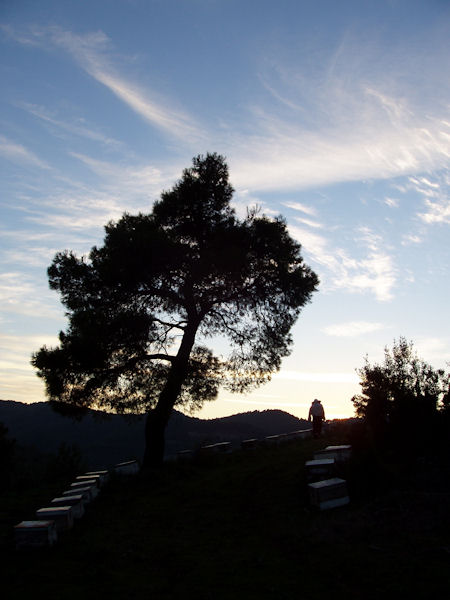
Getting ready to transport.
It is easy to understand that Greek honey is the cooperative product of the bees with one of the riches floras in the world, comprised of many aromatic-pharmaceutical plants and herbs. The DOC Menalo Fir honey (Vanilla) and the Pine Honey, produced by the "Marhalina Hellenica" insect solely in Greece and the Turkish coast, as its name denotes, are both characteristic examples of Greek honey. Honey from Labietae species, with well-known expectorant and cooling activity, and Honey from Erica multipolyflora (thanks to its varied origins) are known for their beneficial effects on human health.
The plant biodiversity found in Greece, however, hides two important points:
- Honey produced in each region varies from year to year, since the weather conditions each year vary and thus influence the nectar production of some plants, which in turn affects the honey produced.
For this reason, all our honey is labeled with the "harvest year" so that each year is associated with a particular flavor. There is, of course, honey from certain areas and plants, which has a constant taste (although not appearance) from year to year (for example, Fir tree honey). Unfortunately, we cannot compare honey produced over many years, because the flavor changes over time. - Most of the areas to which we transport our hives, literally chasing flowers in bloom, are located in difficult-to-reach and rugged places, due to the particularities of the Greek terrain.
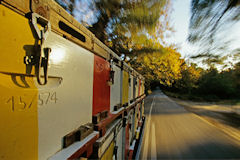
Repeated hive transport.
Almost all the plants which make up the Greek biodiversity puzzle have a very small flowering season (maximum one month, in contrast to other areas of the world where flowering lasts many months), and thus the hives are continually transported from place to place, yielding a very work-intensive honey at a higher cost.
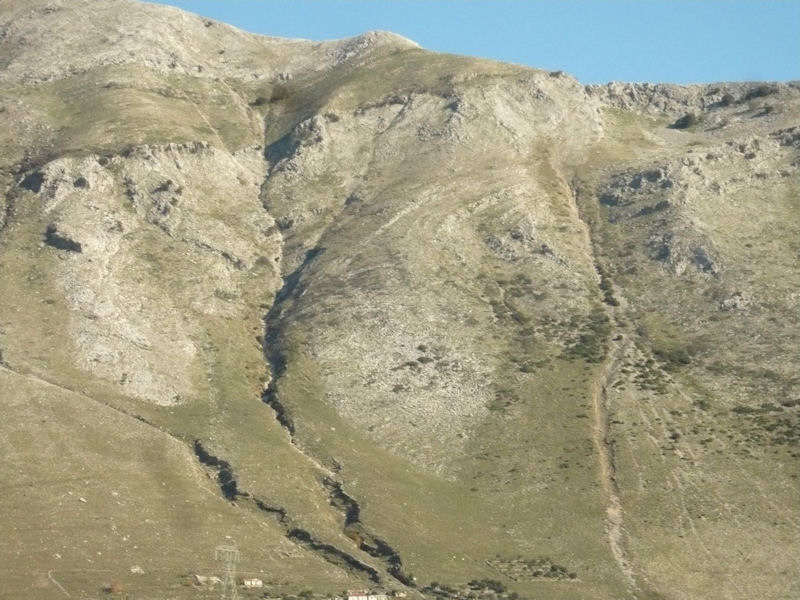
Rugged Greek mountains
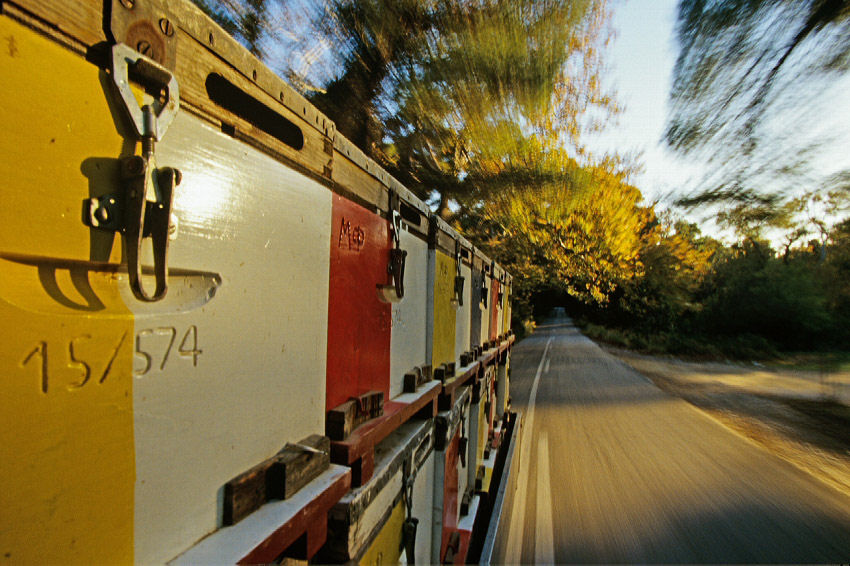
After reading the presentation above, we hope that you can now clearly answer our initial question: "Why Greek honey?"